Operating table ergonomics: surgical access, staff posture and workflow

An operating table does more than position the patient. Its height, base design, tabletop dimensions and controls also influence how closely the surgical team can approach the patient, how comfortably they can work and how easily the table can be adjusted during a procedure.

When comparing operating tables, ergonomics should therefore be considered together with surgical access and workflow. A technically capable table may still be inconvenient in daily use if the working height is unsuitable, the base restricts access or routine adjustments are unnecessarily complicated.

In brief: What matters in operating table ergonomics?

Operating table ergonomics comes from how height range, tabletop width, base and column design, and ease of adjustment work together for your team’s actual procedures — not from any single specification. Compare the complete height-adjustment range rather than just checking for “height adjustable,” check whether the base and column design let the surgical team stand close to the patient, and confirm that height and position changes can be made quickly and reliably during a procedure.

Why operating table height matters for surgical ergonomics

One of the most practical questions surgical teams can ask is:

How low does the operating table actually go?

The appropriate working height depends on the procedure, the surgeon’s stature, the instruments being used and the position of the patient. Recent research supports the importance of adapting the working height to the task. A 2026 ergonomic simulation study in total knee arthroplasty found that adjusting the working height according to ergonomic recommendations reduced surgeons’ postural load.[1] A 2022 narrative review of laparoscopic surgery also identifies operating-table height as one of the important ergonomic factors to consider, together with patient position, port placement and monitor setup.[2]

These findings suggest that there is no single “ideal” operating-table height for every surgeon or procedure. For buyers, the more relevant question is whether the table provides a sufficiently usable height-adjustment range to accommodate different users, surgical techniques and working conditions.

When comparing operating tables, compare the complete height range, not simply check whether a table is described as “height adjustable”.

Consider:

  • the minimum working height
  • the maximum working height
  • the thickness of the mattress or padding
  • the working height required for the procedures you perform
  • differences in height between members of the surgical team

The current Novak M Operating Table Y provides electric height adjustment from 58 to 98 cm without padding.

Can the surgical team stand close enough to the patient?

Table height is only one part of surgical ergonomics. The team must also be able to approach the surgical site without the base or column forcing them into an awkward position.

This makes another buyer question particularly important:

Can I stand close enough to the patient without the base restricting my foot position?

A large or poorly positioned base can prevent the surgeon from moving close to the table. Even a relatively small restriction at floor level can affect how the feet, knees and upper body are positioned during a procedure.

When evaluating an operating table, look at the relationship between:

the tabletop → the column → the base → the position of the surgical team.

Do not judge access only from a product photograph taken from above. When possible, evaluate the table from the actual working position.

Check whether the surgeon and assistants can approach the areas of the patient that need to remain accessible during the procedures performed in your facility.

These principles can also be seen in the design of the Operating Table Y, where the base, column and tabletop are considered together to support surgical access.

Tabletop design also affects surgical access

The dimensions and shape of the tabletop determine how much physical distance remains between the surgical team and the patient.

A wider table can provide more surface area for patient support, but additional width can also increase the distance between the operator and the surgical site. In an internal review of seven current operating table models, published tabletop widths ranged from 50 to 55 cm where the tabletop-only measurement was specified, while overall widths including side rails were approximately 57 to 61 cm. Not all manufacturers define or report these measurements in the same way. This illustrates why width should not be assessed as an isolated number — buyers should also check exactly what the published measurement includes. The appropriate balance depends on the patient population, the procedures performed and the access required by the surgical team.

The current Novak M Operating Table Y has a tabletop width of 55 cm excluding the fixation rails and 60 cm including rails.

Tabletop segmentation can also influence access. Head, back, seat and leg sections may need to move or be removed depending on the procedure. However, the detailed choice of sections and accessories belongs to the overall configuration of the operating table rather than to ergonomics alone.

The more useful question is not: How many sections does the table have?

but:

Does its design allow the surgical team to reach the area they need to work on?

Easy adjustment matters during the procedure

An ergonomic operating table should not only reach an appropriate position. The team should also be able to adjust it without unnecessarily interrupting the workflow.

The buyer should ask a practical question:

How easy is it to change the table height or patient position during a procedure?

Frequently used movements should be straightforward and predictable. If adjusting the table requires unnecessary manual effort or several complicated steps, it can interrupt the workflow and make it more difficult for the team to maintain an appropriate working position.

Electric adjustment allows the table position to be changed while the patient remains supported on the table. Depending on the procedure, relevant movements include:

  • height adjustment
  • lateral tilt
  • Trendelenburg and Anti-Trendelenburg
  • adjustment of individual tabletop sections
  • recall of frequently used positions
  • longitudinal shift

The Novak M Operating Table Y is fully electric and is operated via a hand switch, allowing smooth and precise adjustment of the table during procedures. Its motorized movements include height adjustment, lateral tilt, Trendelenburg and Anti-Trendelenburg, as well as adjustment of individual tabletop sections.

For facilities where the same or similar table positions are used repeatedly, memory functions can further simplify the workflow. Instead of recreating a position through several individual adjustments, frequently used settings can be recalled more efficiently. Operating Table Y includes two memory functions.

explore OPerating table y

Experience from clinical use supports the practical importance of easy table adjustment. At Urology Šainović, precise adjustment of the table height and position is highlighted as contributing to better visibility of the surgical field, more controlled movements and a smoother workflow during urological procedures.[3]

The important question is therefore not simply: How many electric movements does the table have?

but:

Can the surgical team make the adjustments they regularly need simply, precisely and without unnecessary interruption to the procedure?

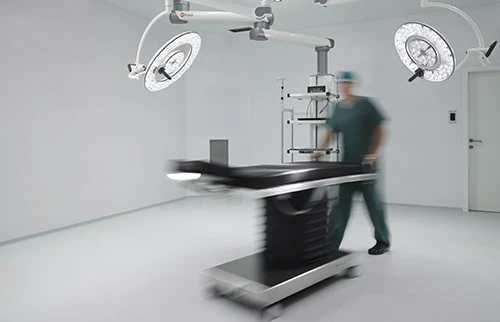
Mobile operating table being moved quickly through a clean operating room.

Mobility and workflow in the operating room

Operating-room workflow is influenced not only by how the table is adjusted during a procedure, but also by how easily it can be moved, positioned and secured where it is needed.

How easy is the operating table to move and position within the operating room?

This can be particularly relevant in operating rooms where the table needs to be repositioned to suit different procedures or room layouts. Mobility depends not only on the castors and braking system, but also on the overall design and weight of the table.

An operating table should be easy to reposition when needed, but once in place it must provide a stable working platform for the procedure.

Clinical experience at Klinika BUT illustrates this practical aspect of everyday use. Prof. Dr. Igor But highlights the table’s height adjustment, flexible positioning angles and particularly its lightness, which allows the team to move it easily around the room.[4]

For buyers, mobility should therefore be evaluated as part of the complete workflow. Consider how often the table will need to be moved, how much space is available in the operating room and how easily staff can position and secure it before the procedure.

The useful question is not simply: Is the operating table mobile?

but:

Can the team move, position and secure it easily when the workflow requires it?

Ergonomics is only one part of the selection process. For a broader overview of what to compare, see our guide to choosing an operating table for day surgery and outpatient procedures.

What should you compare when evaluating operating-table ergonomics?

Check Why it matters
Minimum and maximum table height Determines whether the working level can be adapted to procedures and different users
Tabletop width and design Influences how close the surgical team can work to the patient. Buyers should also check whether the stated width includes fixation rails.
Base and column design Can affect foot space and approach to the surgical site
Electric adjustments and controls Allow controlled adjustment while the patient is positioned on the table and influence how easily the team can make them
Memory function Can reduce repeated setup steps
Mobility and handling Affect repositioning of the table within the operating environment
Stability Good mobility should not come at the expense of a secure working platform once the table is in place.


The most useful assessment is not whether an operating table has each feature, but how those features work together during the procedures your facility actually performs.


Discuss your operating table requirements


Sources:

[1] Sánchez-Robles M, Marín-Martínez C, León-Muñoz VJ, Moya-Angeler J, Lajara-Marco F. Operating Table Height Optimization Reduces Surgeon Postural Load During Total Knee Arthroplasty: An Ergonomic Simulation Study. Journal of Clinical Medicine. 2026;15(7):2782. DOI: 10.3390/jcm15072782

[2] Madhok B, Nanayakkara K, Mahawar K. Safety considerations in laparoscopic surgery: A narrative review. World Journal of Gastrointestinal Endoscopy. 2022;14(1):1–16. DOI: 10.4253/wjge.v14.i1.1

[3] Operating table Y at Urology Šainović. Novak M case study. Accessed 16 September 2026.

[4] Operating table Y at the BUT Clinic. Novak M case study. Accessed 16 September 2026.

contact us
Want to know about new products and technologies?
Subscribe to our newsletter