How to choose an operating table for day surgery

Choosing an operating table for day surgery is not about selecting the model with the longest list of features. The right table is the one that matches your procedure mix, provides the positioning and access your surgical team needs and fits your workflow.
For day surgery centers and outpatient operating rooms, functionality, ease of use and reliability can be more valuable than complexity that is rarely used.

1.    Start with the procedures you actually perform

Before comparing operating tables, define what will happen on the table during a typical working week.

The first question should not be Which operating table should we buy? but:

Which procedures will we perform on it?

A table used mainly for minor general surgery may have different requirements from one used for orthopedics, urology or gynecology. In day surgery, one operating table often supports several surgical specialties.

Start with the procedures rather than the product specifications. Before comparing individual models, define:

  • the procedures you perform regularly
  • the patient positions required
  • whether different specialties will use the same table
  • whether imaging equipment such as a C-arm is used
  • which accessories are essential

This makes it easier to separate essential requirements from features that may rarely or never be used. The procedures should define the operating table — not the other way around.

Versatility is useful when it reflects your real clinical needs. A table that can be adapted efficiently between different procedures can increase the flexibility of the operating room. More functions, however, are not automatically better.

2.    How much positioning flexibility do you need?

Once the procedure mix is clear, identify the table movements required to achieve the necessary patient positions.

Look at the complete range of movements rather than one specification in isolation:

  • height adjustment,
  • Trendelenburg
  • lateral tilt
  • back and leg section movement.

The questions should therefore be practical:

Can the table provide every position we regularly need without unnecessary patient repositioning or workarounds?

Some outpatient operating rooms may need a relatively straightforward configuration, while others require more advanced positioning flexibility.

3.    Consider surgical and imaging access

Patient positioning is only part of the decision. The operating table must also support proper surgical access and operating table ergonomics, allowing the surgical team to work comfortably and reach the patient from the required positions.

Consider which areas of the body need to be accessible during your procedures and whether surgeons, assistants and equipment can approach the table from the required positions.

If imaging equipment such as a C-arm is used during procedures, include this requirement from the beginning of the selection process. Do not simply ask whether an operating table is “C-arm compatible”. Consider where imaging is required and whether the table and its base provide sufficient access in that specific area.

The right question is therefore simply:

Will it give us the access we need for the procedures we actually perform?

4. Plan the configuration around the procedures

Once the clinical requirements are defined, you can determine the actual configuration of the operating table.

This may include decisions about:

  • tabletop sections
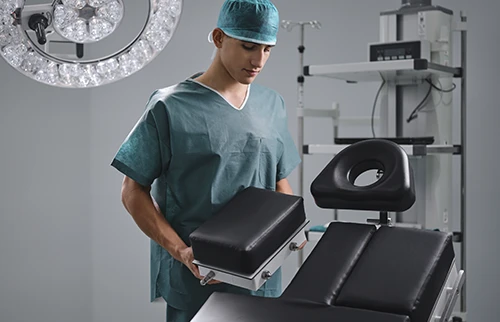
  • headrest
  • leg sections
  • fixation rails
  • arm supports
  • other procedure-specific accessories

Accessories should not be treated as an afterthought. They directly influence how the patient can be positioned and how easily the surgical site can be accessed.

However, there is no need to equip the table with every available accessory from the beginning.

Ask:

Which components do we need for today’s procedures, and which can be added later if our needs change?

Compatibility with a suitable range of accessories may be just as important as the movements of the table itself.

5. Match the table to the outpatient workflow

Day surgery and outpatient operating rooms often need to support several scheduled procedures and, in some facilities, different types of procedures during the same day. This makes ease of use particularly important.

Consider how the table fits into the complete workflow:

  • How easily can it be prepared for the next procedure?
  • Are adjustments intuitive?
  • Can different members of the surgical team operate it easily?
  • Can the required positions be reached without complicated sequences?
  • Does the table need to be repositioned within the operating room?
  • Can accessories be added or removed efficiently?

In day surgery, versatility should simplify the workflow rather than add unnecessary complexity.

A table with many functions has little practical value if those functions make everyday use more complicated without supporting the procedures you perform.

6. Avoid both under-specification and over-specification

Choosing too little functionality can be just as problematic as choosing too much.

Under-specification

Choosing a table that is too basic can limit future procedures or require compromises in positioning and access.

Over-specification

At the other extreme, a highly specialized operating table may provide functions that are rarely relevant to an outpatient facility. This means paying for capabilities that bring little practical value to the actual procedure mix.

The goal is therefore to find the operating table with the right level of functionality for your clinical routine.

A useful approach is to divide requirements into three groups:

Essential – needed for procedures you perform regularly
Procedure-specific – needed only for certain interventions
Future – useful if your surgical program expands

This makes it easier to compare different tables objectively.

7. Do not overlook stability and load limits

Versatility is valuable only if the operating table remains stable throughout the positions and procedures for which it is intended.

When comparing tables, consider the construction of the table, the stability of the base, the locking or braking system and load limits.

Pay particular attention to terminology used for weight limits. Safe working load and maximum patient weight are not necessarily the same value, so check how the manufacturer defines the load specifications.

For example, the current Novak M Operating Table Y has a safe working load of 320 kg and maximum patient weight of 230 kg. This illustrates why the specification itself — and not only the largest number in a product brochure — needs to be understood.

Always compare manufacturer-declared limits and make sure they are appropriate for your intended patient population and procedures.

Explore Operating table Y

8. Consider service and long-term reliability

If an operating table is used regularly, equipment downtime can affect the surgical schedule.

Check before purchase not when problems occur:

  • warranty conditions
  • recommended maintenance
  • availability of spare parts
  • technical support

Find out who provides technical support, which maintenance is required and whether spare parts and service will remain available throughout the expected lifetime of the table.

A table that suits your procedures but is difficult to maintain may become a poor long-term choice.

What should you define before choosing an operating table?

ASK FIRST IT HELPS DETERMINE
Which procedures will we perform? Required functions and overall table configuration
Which patient positions do we need? Required table movements and tabletop sections
Will different specialties use the same table? Required versatility
Do we use a C-arm? Imaging access, radiolucency and base requirements
Which areas of the patient must be accessible? Tabletop and base design
Which accessories are essential? Rails, headrest and accessory configuration
What patient population do we treat? Required load limits
How will the table be used during a typical day? Controls, mobility and workflow requirements
How frequently will the table be used? Reliability, maintenance and service requirements

Frequently asked questions

What should I consider when choosing an operating table for day surgery?

Start with the procedures performed in your facility. The required patient positions, surgical access, imaging needs and accessories should define the operating-table configuration. This helps you choose the level of functionality you actually need.

Does a day surgery operating table need all the functions of a hospital OR table?

Not necessarily. The appropriate level of functionality depends on the procedures performed. A day surgery center carrying out a predictable range of procedures may not need every function available on a highly specialized operating table. However, all functions necessary for safe positioning, surgical access and the intended procedures must be available.

How many operating table functions do I actually need?

There is no ideal number of functions. Identify the movements required for the patient positions used in your procedures and distinguish between essential, procedure-specific and optional functions. More functions do not automatically make a table better suited to your facility.

What should I check if we use a C-arm?

Check where imaging is required during your procedures and whether the table provides adequate radiolucency and physical access for the C-arm in those areas. Base design, tabletop construction and, where needed, longitudinal movement can all affect imaging access.

Can one operating table be used for several surgical specialties?

Yes, if its positioning range, configuration and compatible accessories meet the requirements of each intended procedure. For multidisciplinary use, define the requirements of all relevant specialties before selecting the table.

Choose the table around your clinical routine

The best operating table for a day surgery centre or outpatient facility is not necessarily the most complex one.

It is the table that provides the positioning, stability, surgical access, and flexibility your procedures require while remaining practical for everyday use.

Start with your procedure mix, define the functions you actually need and then configure the table around those requirements. This helps you avoid both under-specification and unnecessary complexity and make a decision based on how the operating table will actually be used every day.

Explore Novak M mobile operating tables, see how operating tables are used in practice at Urology Šainović and Klinika BUT or contact our team if you need help determining which configuration best matches your procedures.

Request a quote
Want to know about new products and technologies?
Subscribe to our newsletter