
How to choose an examination table for your medical practice

The right examination table supports every stage of an appointment, from helping the patient settle into position to giving you comfortable access during the examination.
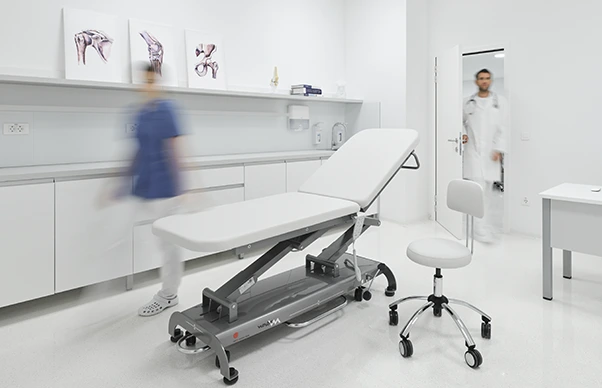
To choose an examination table, start with the examinations you perform, the patients you see and the way your team works. These needs determine the positioning options, height range and tabletop dimensions worth considering. Then compare controls, load limits, cleaning requirements and service support to find a configuration that fits your practice.

Start with the positions your examinations require

Think through a typical appointment. Does the patient lie down throughout the examination, or do you also need a half-seated or sitting position? Do you need access to a particular part of the body? Will the same table serve several medical specialties?

A two-section examination table may provide all the flexibility needed for your work. However, two tables with the same number of sections can offer different support. The length and adjustment angle of the head section determine how it supports the patient when raised.

For example, the  Novak M Examination table SXL – electric has a long head section that supports the patient in a sitting position. Its height is electrically adjustable, while the head section is adjusted manually with gas-spring assistance. Electric height adjustment does not necessarily mean that all tabletop sections are electrically operated.

For specialist examinations, a particular feature may be more relevant than additional sections. At MC Merus in Ljubljana, for example, the selected table includes an opening for cardiac ultrasound. The choice reflects a specific need for access during the cardiac examination.

Before comparing models, identify the positions and access your work requires.

Consider patient access and your working height together

An examination table needs to accommodate two different moments: the patient getting onto the tabletop and the practitioner carrying out the examination. The most suitable height is not necessarily the same for both.

A low entry position can make it easier for patients to get onto the examination table. This is particularly helpful for older patients and those with limited mobility, as the table can be lowered before they sit down.

The upper end of the height range matters too. Once the patient is positioned, you should be able to adjust the surface to the task and your working position. A table shared by several practitioners needs to accommodate differences in their height and whether they work seated or standing.

When comparing models, consider whether the height range suits both seated and standing work. The table should allow you to get close to the patient and reach the examination area comfortably in your usual working position.

nurse's feet stepping on a circular switch for height adjustment of examination table

Choose height adjustment controls that suit your workflow

When choosing a height-adjustable examination table, consider both how the height is adjusted and how you operate it. Electric models may use a circular switch, a foot switch or a hand switch, depending on the model and configuration. Hydraulic models use a foot pedal.

The position of these controls matters during everyday work. Think about where you usually stand or sit, whether you move around the patient and whether you need to keep your hands free while adjusting the height.

Height adjustment control How it is operated What to consider
Circular switch — electric Operated by foot from around the table’s base Useful when you work from different sides of the table and want the control within reach
Foot switch — electric Operated by foot using a control placed on the floor Check whether it can be positioned conveniently for your usual seated or standing work
Hand switch — electric Operated using a handheld control Consider where it can be kept within reach and whether using a hand switch suits your tasks
Foot pedal — hydraulic Operated by foot to raise or lower the table Check which sides provide pedal access and how the raising and lowering actions work

The available controls vary between models, and some tables offer an additional control option. When comparing configurations, check what is included and how it fits the way you work. If you regularly move around the patient, access from several sides may be particularly useful.

Check which controls operate the height and which operate individual tabletop sections.

For a closer look at the options available across the Novak M range, see our comparison of electric, hydraulic and S basic examination tables.

Balance patient support with access for staff

The tabletop should provide enough space to support your patients while allowing you to reach the area being examined. Novak M examination tables are available in widths of 65 and 75 cm. A wider surface provides more room for the patient, but it also increases the distance you may need to reach from the side. When choosing the width, consider both patient support and your own height and reach. You should be able to work close to the patient without having to lean too far across the table.

The shape of the padding also affects how much of that width provides usable support. On Novak M S-line tables, the padding has square edges, while S basic models have more rounded edges. This means that even a 65 cm wide S-line table offers more usable surface than an equally wide S basic model, particularly near the edges where the patient’s arms may rest.

The design of the base also affects how closely you can approach the patient. Even with a suitable tabletop width, a base that leaves little room for your feet or stool can make you work from farther away. Consider the space beneath the table in relation to your usual seated or standing position.

paper roll under the examination table's head section

Consider how the table fits your clinical space

An examination table should fit the room’s layout as well as the way you work. Consider its position in relation to doors, storage and other equipment, leaving enough space for patients and staff to move around it.

Its appearance also contributes to the overall character of your practice. The table’s shape, upholstery color and finishes can complement the interior and create a consistent look across examination and treatment rooms. Novak M’s S-line examination, massage and therapy tables received the Red Dot Award: Product Design 2020.

At LŌRE Clinic in Lucerne, Switzerland, the equipment was selected to support clinical work while fitting naturally into the clinic’s carefully designed interior. As the clinic explains:

“At the same time, they are functional, comfortable, and visually appealing – a combination that is particularly important for a modern practice.” — LŌRE Clinic

Choose a load capacity that matches your patients

Consider the range of patients your practice treats, including heavier patients, when comparing load capacities. The safe working load needs to accommodate the intended load during use, so check how the manufacturer accounts for patient weight, accessories and any additional equipment.

For example, Novak M S-line examination tables have a safe working load of 250 kg, while S basic models have a safe working load of 200 kg. This is a relevant difference when choosing a model for your patient population.

Do not assume that safe working load is the same as maximum patient weight. Check any separately stated patient weight limit, as well as the limits for individual sections and accessories.

young lady patient sitting on treatment table is talking to a doctor

Consider cleaning and service support

When assessing how easy an examination table is to clean, start with the upholstery material, then look beyond the main lying surface. Consider the table’s overall construction: smooth surfaces, clean lines and few joints make cleaning easier. A smooth base cover also helps by keeping the mechanisms enclosed and providing an accessible surface to wipe down.

Accessories should also support your daily cleaning and preparation routines. A conveniently placed paper roll holder keeps a fresh paper covering within reach for the next patient.

Retractable castors make it easier to move the table to clean the floor beneath and around it. Once it is back in place, the castors can be retracted so the table rests firmly on its feet during examinations.

For ongoing support, find out who provides servicing in your area and how to arrange repairs. Ask about spare-part availability and whether worn or damaged upholstery can be replaced.

CTA gumb: 

Explore examination tables

Before you choose: key questions to ask

Consideration Questions to ask
Patient positioning Does the table support the positions your examinations require? Do you need any specialist features or accessories?
Height range Is the entry height suitable for your patients? Does the adjustment range accommodate the staff using the table, seated or standing?
Adjustment controls Can you reach the controls from your usual working positions? How are the height and individual tabletop sections adjusted?
Width and usable surface Does the width and shape of the padding provide enough patient support while allowing you to reach comfortably?
Base design Is there enough room for your feet or stool to work close to the patient?
Room layout and appearance Does the table leave enough room for movement around it? Does its design complement your clinic’s interior?
Load limits Is the safe working load suitable for your patients and equipment? Are there separate limits for patient weight, sections or accessories?
Cleaning and preparation Are the upholstery, edges and base easy to clean? Which accessories would help you prepare the table for the next patient?
Movement for cleaning Can the table be moved to clean beneath and around it, then returned to firm support on its feet?
Service support Who provides local servicing and repairs? Are spare parts and replacement upholstery available?

If you need help choosing a configuration, tell us which examinations you perform, which patient positions you need and how your room is arranged. Our team can help you identify the options that fit your requirements.

Discuss your requirements
Want to know about new products and technologies?
Subscribe to our newsletter